Affichage des articles dont le libellé est Will to Order. Afficher tous les articles

01/02/2014

Agile Democracy against the elimination of the dangers posed by newly empowered individuals


Excerpts from the 08/2013 article "War on Terror Is not the Only Threat" by Harlan Ullman, author of the infamous and shameful doctrine "Shock and Awe" (emphasis mine):
"Hence, the counter-terrorism responses [...] aren't addressing the forces that are dramatically altering the nature of international politics. [...] 
The major enemy and adversary are no longer states bent on disrupting or dominating the system despite those who see China as a future foe. 
Instead, the more immediate danger rests in the dramatic empowerment of individuals and groups, for good and sadly evil, often lumped together as "non-state actors." 
Edward Snowden, Bradley Manning, countless "hackers" and anonymous people [...] whose actions have indeed constituted real threats and systemic disruptions are among the former. Al-Qaida and other radical groups reflect the latter. 
In essence, the 365 year-old Westphalian system that placed sovereign states as the centerpieces of international politics is being tested and in some cases made obsolete by the empowerment of individuals and non-state actors. As former national security adviser Brent Scowcroft observes, global politics has entered a post-Westphalian era. But very few have taken note and fewer have acted on this realization. 
The fundamental cause of this empowerment is the diffusion of all forms of power writ large commonly called "globalization," accelerated by the information revolution and instantaneous global communications and the real and perceived fragilities and weaknesses of states to intervention, interference and disruption by non-traditional actors. 
September 11th could become the demarcation point of this new era much as 1648 and the Treaty of Westphalia marked the beginning of the state-centric system of the international order. 
While the analogy is loose, it won't take centuries for the effects of globalization and the end or at least the transition of the Westphalian era to take hold. 
Beyond this inflection point in international politics, still unabsorbed and misunderstood by most governments and people, a second reality complicates taking effective action in what could truly be a "new world order," the description coined by U.S. President George H.W. Bush after the implosion of the Soviet Union more than two decades ago. 
Failed and failing government from Afghanistan to Zimbabwe with Brussels and Washington in between is the largest collective impediment to the betterment of mankind. 
Without an extraordinary crisis, little is likely to be done to reverse or limit the damage imposed by failed or failing governance. The United States is Exhibit A although there are far too many competitors for that title. 
However, the changing Westphalian system can and must be addressed if there is to be any chance of success in containing, reducing and eliminating the dangers posed by newly empowered non-state actors. 
We have been here before. Sixty-eight years ago this month, the nuclear age dawned over Hiroshima. Over time as nuclear and especially thermonuclear weapons were seen as more than just extensions of conventional munitions and potentially existential, a theory of deterrence emerged. We are at similar juncture regarding cyber where we lack an overarching understanding of the implications and possible consequences of this domain. 
The first step as the Westphalian system faces profound redefinition is understanding and recognizing that these shifts are under way. From that appreciation, specific concepts and ideas can be fashioned to help guide us on this journey.
The path will be difficult and tortuous. Politics and ideological preferences will confuse and distort clear vision. The tendency to overreact, as occurred after September 11th and the Snowden and Manning leaks, will collide with budget realities in which a great deal less will be spent on national security. And because of the pernicious nature of the U.S. system of government, finding institutions with the objectivity, courage and perseverance to chart this new unknown won't be easy. 
Yet this must be done."
You read correctly: Ullman promotes nothing less than an 'overreaction' of the cyber-command organization to "protect" the failing US state, at the expense of the citizens, specifically targeting then eliminating the empowered ones. 

The idea expressed here is to perform an 'Hiroshima' like extraordinary event in or using the Cyber domain and infrastructure, and then make 'deterrence' to emerge. This means all others sheepsuuh..citizens have to fear once for all that the threat from the rulers over them is absolutely real, and that the current State actors will never accept any change in the governance.

Ullman is saying that the infrastructure for such an event is ready, but the government is only lacking a 'clear vision' to fashion new 'national security' concepts, and to allocate new budgets to a 'courageous' security agency. 

If we recognize the failing statist governance and the inevitable emergence of the empowered citizen, Ullman's 'vision' of Will to Order is nothing different than the death of democracy. Americans, first among many others people, needs a Monitory Democracy. The principles of Agile Democracy can help and guide them.

Traité de Westphalie publié le 24/10/1648


22/01/2014

Huxley and the Agile Democracy

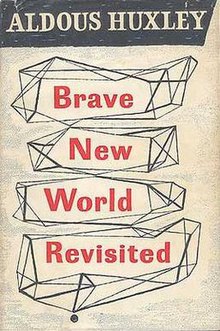
You've surely read Brave New World, but do you know about Brave New World Revisited published 27 years later? Here is how this content is related to the Agile Democracy (special mention to Michael Krieger).


"Under a dictatorship the Big Business, made possible by advancing technology and the consequent ruin of Little Business, is controlled by the State -that is to say, by a small group of party leaders and the soldiers, policemen and civil servants who carry out their orders. 
...
It is in the social sphere, in the realm of politics and economics, that the Will to Order becomes really dangerous. Here the theoretical reduction of unmanageable multiplicity to comprehensible unity becomes the practical reduction of human diversity to subhuman uniformity, of freedom to servitude. 
In politics the equivalent of a fully developed scientific theory or philosophical system is a totalitarian dictatorship. 
In economics, the equivalent of a beautifully composed work of art is the smoothly running factory in which the workers are perfectly adjusted to the machines. 
The Will to Order can make tyrants out of those who merely aspire to clear up a mess. The beauty of tidiness is used as a justification for despotism.

Organization is indispensable; for liberty arises and has meaning only within a self-regulating community of freely cooperating individuals. But, though indispensable, organization can also be fatal. Too much organization transforms men and women into automata, suffocates the creative spirit and abolishes the very possibility of freedom.
...
However hard they try, men cannot create a social organism, they can only create an organization. In the process of trying to create an organism they will merely create a totalitarian despotism.
...
Given a fair chance, human beings can govern themselves, and govern themselves better, though perhaps with less mechanical efficiency, than they can be governed by “authorities independent of their will”. Given a fair chance, I repeat; for the fair chance is an indispensable prerequisite. No people that passes abruptly from a state of subservience under the rule of a despot to the completely unfamiliar state of political independence can be said to have a fair chance of making democratic institutions work.
...
“[Political] parties,” we were told in 1956 by the editor of a leading business journal, “will merchandize their candidates and issues by the same methods that business had developed to sell goods. These include scientific selection of appeals and planned repetition"…The political merchandisers appeal only to the weakness of voters, never to their potential strength. They make no attempt to educate the masses into becoming fit for self-government, they are content merely to manipulate and exploit them.
...
Freedom is therefore a great good, tolerance a great virtue and regimentation a great misfortune.

The genetic standardization of individuals is still impossible; but Big Government and Big Business already posses, or will very soon possess, all the techniques for mind-manipulation described in Brave New World, along with others of which I was too unimaginative to dream. Lacking the ability to impose genetic uniformity upon embryos, the rulers of tomorrow’s over-populated and over-organized world will try to impose social and cultural uniformity upon adults and their children. To achieve this end, the will (unless prevented) make use of all the mind-manipulating techniques at their disposal and will not hesitate to reinforce these methods of non-rational persuasion by economic coercion and threats of physical violence. If this kind of tyranny is to be avoided, we must begin without delay to educate ourselves and of children for freedom and self-government.
...
Under the relentless thrust of accelerating over-population and increasing over-organization, and by means of ever more effective methods of mind-manipulation, the democracies will change their nature; the quaint old forms —elections, parliaments, Supreme Courts and all the rest— will remain. The underlying substance will be a new kind of non-violent totalitarianism. All the traditional names, all the hallowed slogans will remain exactly what they were in the good old days. Democracy and freedom will be the theme of every broadcast and editorial —but Democracy and freedom in a strictly Pickwickian sense. Meanwhile the ruling oligarchy and its highly trained elite of soldiers, policemen, thought-manufacturers and mind-manipulators will quietly run the show as they see fit.

Or take the right to vote. In principle, it is a great privilege. In practice, as recent history has repeatedly shown, the right to vote, by itself, is no guarantee of liberty.Therefore, if you wish to avoid dictatorship by referendum, break up modern society’s merely functional collectives into self-governing, voluntarily co-operating groups, capable of functioning outside the bureaucratic systems of Big Business and Big Government."

(A. Huxley, 1894 – 1963 ; Brave New World Revisited, 1958)
______________

In short: the Manifesto for Agile Democracy is an innovative proposition for such self-governing, voluntarily co-operating groups.