Affichage des articles dont le libellé est MDAD. Afficher tous les articles

01/02/2014

Agile Democracy against the elimination of the dangers posed by newly empowered individuals


Excerpts from the 08/2013 article "War on Terror Is not the Only Threat" by Harlan Ullman, author of the infamous and shameful doctrine "Shock and Awe" (emphasis mine):
"Hence, the counter-terrorism responses [...] aren't addressing the forces that are dramatically altering the nature of international politics. [...] 
The major enemy and adversary are no longer states bent on disrupting or dominating the system despite those who see China as a future foe. 
Instead, the more immediate danger rests in the dramatic empowerment of individuals and groups, for good and sadly evil, often lumped together as "non-state actors." 
Edward Snowden, Bradley Manning, countless "hackers" and anonymous people [...] whose actions have indeed constituted real threats and systemic disruptions are among the former. Al-Qaida and other radical groups reflect the latter. 
In essence, the 365 year-old Westphalian system that placed sovereign states as the centerpieces of international politics is being tested and in some cases made obsolete by the empowerment of individuals and non-state actors. As former national security adviser Brent Scowcroft observes, global politics has entered a post-Westphalian era. But very few have taken note and fewer have acted on this realization. 
The fundamental cause of this empowerment is the diffusion of all forms of power writ large commonly called "globalization," accelerated by the information revolution and instantaneous global communications and the real and perceived fragilities and weaknesses of states to intervention, interference and disruption by non-traditional actors. 
September 11th could become the demarcation point of this new era much as 1648 and the Treaty of Westphalia marked the beginning of the state-centric system of the international order. 
While the analogy is loose, it won't take centuries for the effects of globalization and the end or at least the transition of the Westphalian era to take hold. 
Beyond this inflection point in international politics, still unabsorbed and misunderstood by most governments and people, a second reality complicates taking effective action in what could truly be a "new world order," the description coined by U.S. President George H.W. Bush after the implosion of the Soviet Union more than two decades ago. 
Failed and failing government from Afghanistan to Zimbabwe with Brussels and Washington in between is the largest collective impediment to the betterment of mankind. 
Without an extraordinary crisis, little is likely to be done to reverse or limit the damage imposed by failed or failing governance. The United States is Exhibit A although there are far too many competitors for that title. 
However, the changing Westphalian system can and must be addressed if there is to be any chance of success in containing, reducing and eliminating the dangers posed by newly empowered non-state actors. 
We have been here before. Sixty-eight years ago this month, the nuclear age dawned over Hiroshima. Over time as nuclear and especially thermonuclear weapons were seen as more than just extensions of conventional munitions and potentially existential, a theory of deterrence emerged. We are at similar juncture regarding cyber where we lack an overarching understanding of the implications and possible consequences of this domain. 
The first step as the Westphalian system faces profound redefinition is understanding and recognizing that these shifts are under way. From that appreciation, specific concepts and ideas can be fashioned to help guide us on this journey.
The path will be difficult and tortuous. Politics and ideological preferences will confuse and distort clear vision. The tendency to overreact, as occurred after September 11th and the Snowden and Manning leaks, will collide with budget realities in which a great deal less will be spent on national security. And because of the pernicious nature of the U.S. system of government, finding institutions with the objectivity, courage and perseverance to chart this new unknown won't be easy. 
Yet this must be done."
You read correctly: Ullman promotes nothing less than an 'overreaction' of the cyber-command organization to "protect" the failing US state, at the expense of the citizens, specifically targeting then eliminating the empowered ones. 

The idea expressed here is to perform an 'Hiroshima' like extraordinary event in or using the Cyber domain and infrastructure, and then make 'deterrence' to emerge. This means all others sheepsuuh..citizens have to fear once for all that the threat from the rulers over them is absolutely real, and that the current State actors will never accept any change in the governance.

Ullman is saying that the infrastructure for such an event is ready, but the government is only lacking a 'clear vision' to fashion new 'national security' concepts, and to allocate new budgets to a 'courageous' security agency. 

If we recognize the failing statist governance and the inevitable emergence of the empowered citizen, Ullman's 'vision' of Will to Order is nothing different than the death of democracy. Americans, first among many others people, needs a Monitory Democracy. The principles of Agile Democracy can help and guide them.

Traité de Westphalie publié le 24/10/1648


21/07/2013

About the authority and the discipline required by the government of self

"It is the characteristic of privilege and of every privileged position to kill the mind and heart of men. The privileged man, whether practically or economically, is a man depraved in mind and heart. That is a social law which admits of no exception, and is as applicable to entire nations as to classes, corporations and individuals. It is the law of equality, the supreme condition of liberty and humanity. [...]
A scientific body to which had been confided the government of society would soon end by devoting itself no longer to science at all, but to quite another affair; and that affair, as in the case of all established powers, would be its own eternal perpetuation by rendering the society confided to its care ever more stupid and consequently more in need of its government and direction.
But that which is true of scientific academies is also true of all constituent and legislative assemblies, even those chosen by universal suffrage. In the latter case they may renew their composition, it is true, but this does not prevent the formation in a few years' time of a body of politicians, privileged in fact though not in law, who, devoting themselves exclusively to the direction of the public affairs of a country, finally form a sort of political aristocracy or oligarchy. Witness the United States of America [...].
Consequently, no external legislation and no authority - one, for that matter, being inseparable from the other, and both tending to the servitude of society and the degradation of the legislators themselves.
Does it follow that I reject all authority? Far from me such a thought. In the matter of boots, I refer to the authority of the bootmaker; concerning houses, canals, or railroads, I consult that of the architect or the engineer. For such or such special knowledge I apply to such or such a savant. But I allow neither the bootmaker nor the architect nor the savant to impose his authority upon me. I listen to them freely and with all the respect merited by their intelligence, their character, their knowledge, reserving always my incontestable right of criticism and censure. I do not content myself with consulting a single authority in any special branch; I consult several; I compare their opinions, and choose that which seems to me the soundest. But I recognise no infallible authority, even in special questions; consequently, whatever respect I may have for the honesty and the sincerity of such or such an individual, I have no absolute faith in any person. Such a faith would be fatal to my reason, to my liberty, and even to the success of my undertakings; it would immediately transform me into a stupid slave, an instrument of the will and interests of others.
If I bow before the authority of the specialists and avow my readiness to follow, to a certain extent and as long as may seem to me necessary, their indications and even their directions, it is because their authority is imposed on me by no one, neither by men nor by God. Otherwise I would repel them with horror, and bid the devil take their counsels, their directions, and their services, certain that they would make me pay, by the loss of my liberty and self-respect, for such scraps of truth, wrapped in a multitude of lies, as they might give me.
I bow before the authority of special men because it is imposed on me by my own reason. I am conscious of my own inability to grasp, in all its detail, and positive development, any very large portion of human knowledge. The greatest intelligence would not be equal to a comprehension of the whole. Thence results, for science as well as for industry, the necessity of the division and association of labour. I receive and I give - such is human life. Each directs and is directed in his turn. Therefore there is no fixed and constant authority, but a continual exchange of mutual, temporary, and, above all, voluntary authority and subordination."
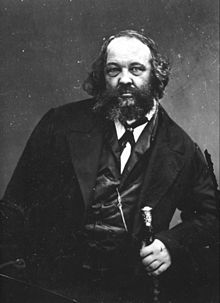
Mikhaïl Aleksandrovitch Bakunin (1814 - 1876); from God and the State, written in 1871. The source does not mention the exact translation used.

Put into application, the principles of Manifesto for an Agile Development of Democratie (MDAD) allow to avoid each pitfall mentioned by Bakunin.

Sur l'autorité et la discipline qu'exige le gouvernement de soi

"C'est le propre du privilège et de toute position privilégiée que de tuer l'esprit et le coeur des hommes. L'homme privilégié soit politiquement, soit économiquement, est un homme intellectuellement et moralement dépravé. Voilà une loi sociale qui n'admet aucune exception, et qui s'applique aussi bien à des nations tout entières qu'aux classes, aux compagnies et aux individus. C'est la loi de l'égalité, condition suprême de la liberté et de l'humanité. [...]
Un corps scientifique auquel on aurait confié le gouvernement de la société finirait bientôt par ne plus s'occuper du tout de science, mais d'une tout autre affaire; et cette affaire, l'affaire de tous les pouvoirs établis, serait de s'éterniser en rendant la société confiée à ses soins toujours plus stupide et par conséquent plus nécessiteuse de son gouvernement et de sa direction.
Mais ce qui est vrai pour les académies scientifiques l'est également pour toutes les assemblées constituantes et législatives, lors même qu'elles sont issues du suffrage universel. Ce dernier peut en renouveler la composition, il est vrai, ce qui n'empêche pas qu'il ne se forme en quelques années un corps de politiciens, privilégiés de fait, non de droit, qui, en se vouant exclusivement à la direction des affaires publiques d'un pays, finissent par former une sorte d'aristocratie ou d'oligarchie politique. Voir les États-Unis d'Amérique [...]. Ainsi, point de législation extérieure et point d'autorité, l'une étant d'ailleurs inséparable de l'autre, et toutes les deux tendant à l'asservissement de la société et à l'abrutissement des législateurs eux-mêmes.
S'ensuit-il que je repousse toute autorité? Loin de moi cette pensée. Lorsqu'il s'agit de bottes, j'en réfère à l'autorité du cordonnier; s'il s'agit d'une maison, d'un canal ou d'un chemin de fer, je consulte celle de l'architecte ou de l'ingénieur. Pour telle science spéciale, je m'adresse à tel savant. Mais je ne m'en laisse imposer ni par le cordonnier, ni par l'architecte, ni par le savant. Je les écoute librement et avec tout le respect que méritent leur intelligence, leur caractère, leur savoir, en réservant toutefois mon droit incontestable de critique et de contrôle. Je ne me contente pas de consulter une seule autorité spécialiste, j'en consulte plusieurs; je compare leurs opinions, et je choisis celle qui me paraît la plus juste. Mais je ne reconnais point d'autorité infaillible, même dans les questions toutes spéciales; par conséquent, quelque respect que je puisse avoir pour l'honnêteté et pour la sincérité de tel ou de tel autre individu, je n'ai de foi absolue en personne. Une telle foi serait fatale à ma raison, à ma liberté et au succès même de mes entreprises; elle me transformerait immédiatement en un esclave stupide et en un instrument de la volonté et des intérêts d'autrui.
Si je m'incline devant l'autorité des spécialistes et si je me déclare prêt à en suivre, dans une certaine mesure et pendant tout le temps que cela me paraît nécessaire, les indications et même la direction, c'est parce que cette autorité ne m'est imposée par personne, ni par les hommes ni par Dieu. Autrement je les repousserais avec horreur et j'enverrais au diable leurs conseils, leur direction et leur science, certain qu'ils me feraient payer par la perte de ma liberté et de ma dignité humaines les bribes de vérité, enveloppées de beaucoup de mensonges, qu'ils pourraient me donner.
Je m'incline devant l'autorité des hommes spéciaux parce qu'elle m'est imposée par ma propre raison. J'ai conscience de ne pouvoir embrasser dans tous ses détails et ses développements positifs qu'une très petite partie de la science humaine. La plus grande intelligence ne suffirait pas pour embrasser le tout. D'où résulte, pour la science aussi bien que pour l'industrie, la nécessité de la division et de l'association du travail. Je reçois et je donne, telle est la vie humaine. Chacun est autorité dirigeante et chacun est dirigé à son tour. Donc il n'y a point d'autorité fixe et constante mais un échange continu d'autorité et de subordination mutuelles, passagères et surtout volontaires."
Mikhaïl Aleksandrovitch Bakunin (1814 - 1876); extrait de Dieu et l'état, rédigé en 1871. La source ne précise pas la version exacte de la publication utilisée.

La mise en application des principes du Manifeste pour le Développement Agile de la Démocratie (MDAD) permettrent d'éviter chacun des écueils repérés par Bakounine.

30/12/2011

Manifesto for Agile Development of Democracy : Recipes


Mathew Lowry asks me some interesting questions about the Manifesto for Agile Development of Democracy (#MDAD). Thanks for that ! Here are my answers : 
“ It leaves me perplexed for two reasons.

To begin with, you claim it values “Individuals and their discussions … democracy and citizenship … Collaboration with the citizens” and so on more than anything else. But was it actually created through a democratic, collaborative process with citizens, or just dreamt up by you in your bedroom?”
Firstly : the origin of the idea comes from my own experience as citizen activism with NewropMag team, my experience about how to introduce agile practices into complex organizations, and previous work. And I give in the first sentence the link for detailed explanations (in French : you have to use Google translate, sorry) why this MDAD proposition is not Utopia, nor even Realistic Utopia : De l’utopie réaliste à l’anticipation politique. BTW, you seem to be sarcastic when you use the verb “dream”, don’t you ? 

Secondly : the Manifest is not in its final version ! You should have noticed the “v20111210” version number and the CC licence. This manifesto is intended to be improved using the same principles described in the manifesto : “eat your own dog food” recipe is very efficient for improvement. So if you like to contribute (or even fork), please do !
Secondly, I use Agile development at work to build opensource websites, and I don’t really see the link between it and your Manifesto. You use some agile language when you talk about optimizing for democracy (“policies with high added value for democracy … Agile political processes harness change for the citizen’s advantage … Define evolution of a real democracy with a frequency of several weeks”). 
Why would you think building software is fundamentally different than building anything else ? I had the luck in my life to work in very different domains and to study even more ones, and by essence they are all the same : what is important is not what you are building, but the team who is building. The relations between the people. The stronger you can make them, the better the result will be. 

Looks to the Agile Manifesto for Software Development. What did they say ? Exactly that. And they have defined principles to optimize these relations. 

Now looks to public policies. It is another name for “defining rules to better live together”. Doesn’t it look similar to defining the correct software requirements ? So why some Agile principles would not be a relevant answer to optimize the way they are defined ? I’m quite sure they are. 

However, you don’t propose any indicators, nor measurement methods, nor arbitrators. Who is the client? Who is the project manager? 
I could have proposed some of them, it’s pretty easy when you have accepted in your mind the underlying logic. But firstly I think the process to define MUST be fully collaborative, and secondly it is a goal for the second part of the story. The first part if to have this Manifesto improved, translated then signed by as many people as possible, who will agree to sign a few sentences they can quickly understand and approved (nothing is hidden in the middle of hundreds or thousands of pages). 

And most important, this MDAD Manifesto does not deal with a single one set of democratic processes : like with software development, many different Agile methods can be defined and used : all are different by some aspects, but all are Agile if they respect the Agile Manifesto principles. None are systematically better than any other. It is the same for democratic processes. Do not start by thinking a single one democratic process "one size fits all" is the obvious way. It is not. That's why we need to define upfront common principles at a upper conceptual layer. Theses principles can then be realized (implemented) differently within different contexts, allowing more efficiency, and more opportunities for people to adopt the principles. It worked like this for Agile Manifesto and changed the way almost all new software is done on earth. KISS recipe at work.

Do you think your remark is relevant when you decided to sign the Agile Manifesto for Software Development (you said you are using Agile methodology in your development work) ? Of course not. 

But if you want to proceed even further, here is the mapping I created between software development roles and roles in an Agile Democracy, and between activities :

 software
Real Democracy
individuals (speaking of team member)
(Same)
Cascade or « V style » development process
Current membership of parliament
interactions
Debate
tools
Current institutions
client
Citizen
fonctionnalities
Public policies
Working software
(set of public policies defined using) real democratic processes
documentation
Rights, rules
to deal a contract before realizing the project
To negotiate an electoral mandate based on the promises of a defined political agenda.
change management
Policies adaptation and political anticipation
Follow a plan
Follow a defined political agenda (or your own)
Deliver software
Define public policies
business people
An elected person
Business sponsor
Sponsor (Current institutions, NGO, think tank…)
Product Owner
An elected person
Product Owner Proxy
Technocrat, civil servant (non elected person)
Scrum Master
A member of the team who helps others to follow the chosen Agile Democracy methodology
developers
Members of citizen think tank or workgroup
development team
citizen think tank or workgroup, members of civil society
End user
Citizen
development 
Definition of public policies or strategic recommendations
Agile coach
Coach in Agile Democracy
External parties
Lobbies

"Your manifesto’d be hijacked by undemocratic interests in months, if not weeks."
To my mind, undemocratic interests are only moving in reactive mode. They simply ignore what they cannot see. They will be interested in MDAD only when it will be a success, means too late. And before that day, what hijack can they do with just an idea and a text under CC licence ?

Mathew, I hope you can participate and improve this MDAD initiative. Just by asking more questions if you wish.

10/12/2011

Manifesto para o Desenvolvimento Ágil da Democracia


"Estamos descobrindo maneiras melhores de melhorar ou expandir a prática da democracia e da cidadania por fazê-lo e ajudar os outros fazê-lo.

Através deste trabalho e engajamento dos cidadãos que têm vindo a valorizar:
  • Indivíduos e suas discussões mais do que a representação tradicional e as instituições eleitorais. 
  • Verdadeira democracia e cidadania mais do que a legislação exaustiva e regulamentos. 
  • Colaboração com a mais cidadãos do que a negociação de um mandato eleitoral com base em promessas de uma agenda política. 
  • A antecipação de adaptação e políticos mais do que seguir uma agenda política. 
Em outras palavras, embora haja valor na parte posterior de cada frase, nós apreciamos mais o primeiro."

Leia Por que este manifesto? e Princípios por trás do Manifesto para o Desenvolvimento Ágil da Democracia

Manifesto per lo Sviluppo Agile della Democrazia


"Siamo costantemente alla scoperta di come migliorare o espandere attraverso la pratica della democrazia de cittadini e aiutarando gli altri in questa pratica.

Questo impegno civico ci ha portato ad apprezzare questi valori:
  • Gli individui e le loro discussioni più che le rappresentazioni elettorali tradizionali e le istituzioni. 
  • L'esercizio della cittadinanza e di una democrazia reale più che delle leggi e regolamenti più complete. 
  • La collaborazione con i cittadini più che la negoziazione di un mandato elettorale basata sulla base di promesse di un programma politico. 
  • L'adattamento e l’anticipazione politica più che il seguire un programma politico. 
In altre parole, anche se c'è un valore nella seconda frase di ogni proposta, noi apprezziamo di più la prima. "

Leggere: "Perché questo manifesto? e Principi Fondatori del Manifesto per lo Sviluppo Agile della Democrazia"

Manifest für Agile Entwicklung der Demokratie


"Wir entdecken bessere Wege zur Verbesserung oder Erweiterung der Praxis der Demokratie und Staatsbürgerschaft, indem Sie es und anderen dabei helfen.

Durch diese Arbeit und bürgerschaftliches Engagement haben wir den Wert zu kommen:
  • Individuen und ihre Diskussionen über die traditionelle Volksvertretung und Institutionen. 
  • Echte Demokratie und Staatsbürgerschaft mehr als abschließende Gesetzgebung und Vorschriften. 
  • Die Zusammenarbeit mit den Bürgern über die Aushandlung eines Mandats, das Versprechen einer politischen Agenda. 
  • Die Anpassung und der politischen Erwartung mehr als nach einer politischen Agenda. 
In anderen Worten, obwohl es sinnvoll ist, im späteren Teil eines jeden Satzes, wir schätzen mehr die früheren."

Lesen Sie : "Warum dieses Manifest? und Prinzipien, die hinter dem Manifest für Agile Entwicklung der Demokratie"

Manifiesto por el Desarrollo ágil de la Democracia


"Estamos descubriendo mejores maneras de mejorar o ampliar la práctica de la democracia y la ciudadanía por hacerlo y ayudar a otros a hacerlo.

A través de este compromiso de trabajo y de los ciudadanos que han llegado a valorar:
  • Las personas y sus conversaciones más que la representación tradicional e instituciones electorales. 
  • La verdadera democracia y la ciudadanía más allá de la legislación y las regulaciones exhaustivas. 
  • Colaboración con el mayor número de ciudadanos de la negociación de un mandato electoral basada en las promesas de una agenda política. 
  • La anticipación política y adaptación más que seguir una agenda política. 
En otras palabras, aunque hay un valor en la parte posterior de cada oración, apreciamos más la primera. "

Lea ¿Por qué este manifiesto? y Principios detrás del Manifiesto por el desarrollo ágil de la Democracia

Manifesto for Agile Development of Democracy


"We are uncovering better ways of improving or expanding the practice of democracy and citizenship by doing it and helping others do it.

Through this work and citizen engagement we have come to value :
  • Individuals and their discussions more than the traditional electoral representation and institutions. 
  • Real democracy and citizenship more than exhaustive legislation and regulations. 
  • Collaboration with the citizens more than the negotiation of an electoral mandate based on the promises of a political agenda. 
  • The adaptation and political anticipation more than following a political agenda. 
In other words, although there is value in the later part of each sentence, we appreciate more the former. "

Read "Why this Manifesto for Agile Development of Democracy and the 12 Principles behind it."

Manifeste pour le Développement Agile de la Démocratie


"Nous découvrons constamment comment améliorer ou développer la démocratie par la pratique citoyenne et en aidant les autres dans cette pratique.

Cet engagement citoyen nous a amené à apprécier ces valeurs :
  • Les individus et leurs débats davantage que les representations électorales traditionnelles et les institutions. 
  • L'exercice de la citoyenneté et une démocratie réelle davantage que des lois et règlements exhaustifs. 
  • La collaboration avec les citoyens davantage que la négociation d'un mandat electoral sur la base des promesses d'un programme politique. 
  • L’adaptation et l'anticipation politique davantage que le suivi d’un programme politique. 
Autrement dit, bien qu'il y ait de la valeur dans les secondes propositions de chaque phrase, nous apprécions davantage les premieres."